
Wheel Balancing vs. Wheel Alignment: Which Service Does Your Vehicle Actually Need?
When drivers start comparing wheel balancing vs. wheel alignment, they’re usually experiencing a symptom rather than looking for a definition. Maybe the steering wheel shakes at highway speeds, the vehicle pulls to one side, or a tire inspection revealed uneven tread wear.
The challenge is that wheel balancing, wheel alignment, and tire rotation are often discussed together, even though they solve different problems.
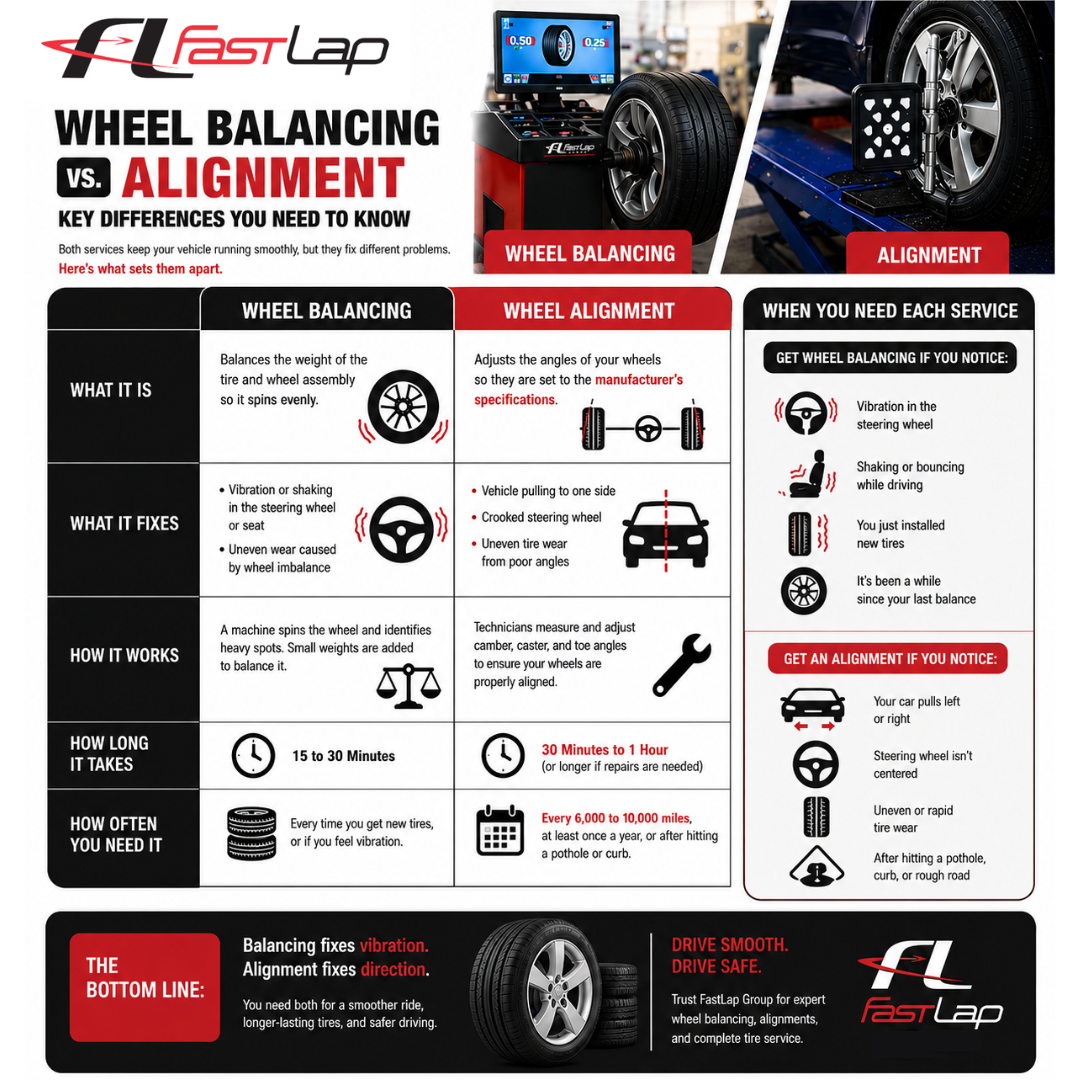
The simplest way to think about it is this: wheel balancing corrects weight distribution, while wheel alignment corrects wheel positioning. Understanding that difference can help you identify problems earlier, protect your tires, and avoid paying for a service that won’t address the actual issue.
The Key Difference Between Wheel Balancing and Wheel Alignment
Wheel balancing addresses uneven weight within the tire and wheel assembly. When a wheel is out of balance, it can create vibration that becomes more noticeable at higher speeds.
Wheel alignment deals with the angles of the wheels and suspension components. Alignment affects how the vehicle tracks, steers, and wears its tires over time.
| Service | What It Corrects | Common Symptoms |
|---|---|---|
| Wheel Balancing | Uneven weight distribution in the tire and wheel assembly | Vibration at certain speeds, steering wheel shake, rough ride |
| Wheel Alignment | Wheel and suspension angles | Pulling, off-center steering wheel, uneven tire wear |
If your vehicle is pulling, wearing tires unevenly, or showing other signs of misalignment, FastLap Auto Repair provides professional wheel alignment service in Oklahoma City to measure and correct wheel angles according to your vehicle’s specifications.
What Wheel Balancing Actually Does
Wheel balancing corrects small weight differences within the tire and wheel assembly. Even brand-new tires and wheels can contain slight manufacturing variations that affect how evenly the assembly rotates.
As speed increases, a heavier portion of the wheel and tire can create vibration. Depending on which wheel is affected, the driver may feel that vibration through the steering wheel, seat, or floor of the vehicle.
During a balancing service, technicians mount the wheel and tire assembly on a computerized balancing machine. The machine identifies areas of imbalance and determines where corrective wheel weights should be installed.
The goal is to help the tire and wheel assembly rotate smoothly and evenly.
Common Signs of an Out-of-Balance Wheel
- Steering wheel vibration at highway speeds
- Floorboard or seat vibration
- A vibration that appears only within a certain speed range
- Irregular tire wear
- A rough or shaky ride on otherwise smooth pavement
Balancing is often associated with ride comfort, but a severe imbalance can also place additional stress on tires, steering components, and suspension parts.
What Wheel Alignment Actually Does
Wheel alignment focuses on the geometry of the vehicle’s steering and suspension system. Manufacturers specify wheel angles that determine how the tires contact the road, track in a straight line, and respond during steering.
When those angles move outside specification, the vehicle may pull to one side, the steering wheel may sit off-center, or the tires may begin wearing unevenly.
A professional alignment typically evaluates three primary measurements: camber, toe, and caster.
Camber
Camber refers to the inward or outward tilt of the tire when viewed from the front of the vehicle. If the top of the tire leans inward, it has negative camber. If it leans outward, it has positive camber.
Camber affects how the tire’s tread contacts the road. When camber is outside manufacturer specifications, vehicle weight can become concentrated on one side of the tread rather than being distributed evenly.
Excessive negative camber may contribute to inside-edge tire wear, while excessive positive camber may contribute to outside-edge wear.
Because camber changes may develop gradually, unusual shoulder wear on the tires can sometimes be one of the first visible signs of an alignment issue.
Toe
Toe describes whether the tires point slightly inward or outward when viewed from above.
When toe settings are correct, the tires roll in the intended direction. When toe is outside specification, the tires can scrub slightly across the road rather than rolling freely.
Over time, this can contribute to rapid or feathered tread wear. Drivers may also notice an off-center steering wheel or a vehicle that feels less settled when traveling straight.
Caster
Caster affects steering feel and directional stability. It refers to the angle of the steering axis when viewed from the side of the vehicle.
Proper caster helps the steering naturally return toward center after a turn and contributes to straight-line stability.
Caster problems generally don’t affect tire wear as aggressively as camber or toe, but they can contribute to wandering, changes in steering feel, or a pull when caster differs significantly from one side of the vehicle to the other.
How to Tell Whether You Need Wheel Balancing, Wheel Alignment, or Both
Some symptoms overlap, but how and when the symptom occurs can provide useful clues.
You May Need Wheel Balancing If…
Balancing problems are often speed-sensitive. A vehicle may drive normally around town but begin vibrating once speeds increase.
Common symptoms include:
- Steering wheel shake at highway speeds
- Vibration that appears only at certain speeds
- Vibration through the seat or floor
- A rough ride despite smooth pavement
If the vehicle drives straight but vibrates at speed, wheel balance or a tire issue may be worth inspecting.
You May Need a Wheel Alignment If…
Alignment problems more often affect how the vehicle tracks and steers.
Common symptoms include:
- Pulling or drifting to one side
- An off-center steering wheel
- Constant steering correction
- Uneven wear along tire edges
- Changes in straight-line stability
Because alignment problems often develop gradually, drivers may adjust to them without realizing something has changed until unusual tire wear becomes visible.
You May Need Both Services If…
Some situations can affect both alignment and wheel balance.
For example, a strong pothole or curb impact may affect suspension geometry while also damaging a tire or wheel or dislodging a balancing weight.
If your vehicle both pulls and vibrates, an inspection can help determine whether alignment, wheel balance, tire condition, suspension problems, or a combination of issues is responsible.
What Your Tire Wear Pattern May Be Telling You
Your tires can provide useful clues about what’s happening with alignment, balance, suspension, and inflation.
Inside- or outside-edge wear can sometimes point toward an alignment issue involving camber or toe. Feathered tread can also be associated with incorrect toe settings.
Cupping, scalloping, or patchy wear may be associated with tire balance, worn shocks or struts, suspension issues, or other conditions that allow the tire to move excessively as it travels.
No wear pattern identifies a single cause with certainty, so tire condition should be evaluated along with alignment measurements, suspension condition, tire pressure, and vehicle symptoms.
How Does Wheel Alignment Affect Tire Wear?
Wheel alignment plays an important role in how evenly your tires contact the road. When wheel angles are outside specification, certain areas of the tread may carry more load than intended.
Over time, this can lead to uneven or premature tire wear.
Correcting an alignment issue can help prevent additional abnormal wear, but it cannot restore tread that has already worn away. That’s why it’s worth investigating pulling, an off-center steering wheel, or unusual tire wear when those symptoms first appear.
Tire pressure, suspension condition, driving habits, tire rotation, and wheel balance can also affect tread life. If your tires are wearing unusually, FastLap can inspect the vehicle and determine which factors may be contributing.
Why New Tires Can Reveal Existing Alignment Problems
Sometimes a vehicle seems to drive normally until a new set of tires is installed. After replacement, the driver may suddenly notice pulling or a change in steering feel.
In some cases, the alignment issue was already present. Worn tires can develop tread patterns that partially mask the way an alignment problem feels. New tires restore a more consistent tread surface, which can make an existing problem easier to notice.
If the tires being replaced show unusual wear, checking the vehicle’s alignment can help prevent the same pattern from developing on the new set.
Do You Need an Alignment When You Get New Tires?
New tires do not automatically mean your vehicle requires a wheel alignment. However, tire replacement is a good opportunity to review how the old tires wore.
An alignment check may be worthwhile if:
- The old tires show uneven wear
- The vehicle pulls to one side
- The steering wheel sits off-center
- Suspension or steering components have recently been replaced
- The vehicle recently experienced a major pothole or curb impact
Correcting an alignment problem early can help protect your investment in a new set of tires.
What Causes Wheel Alignment Problems?
Alignment can change gradually as steering and suspension components wear, but road impacts can also move the vehicle outside its intended specifications.
Common causes include:
- Potholes
- Curb impacts
- Rough or uneven roads
- Worn suspension components
- Steering or suspension repairs
- Changes in vehicle ride height
If the vehicle suddenly begins pulling or the steering wheel changes position after a road impact, having the alignment and suspension inspected can help determine whether anything was damaged.
Why Oklahoma City Roads Can Contribute to Alignment Problems
Driving conditions around Oklahoma City can place regular stress on tires, wheels, steering, and suspension components. Potholes, expansion joints, construction zones, uneven pavement, and daily highway driving can all contribute to wear over time.
Alignment problems don’t always happen after one dramatic impact. Small changes can accumulate gradually as suspension components absorb normal road conditions.
If you notice changes in handling, steering position, or tire wear, an alignment inspection can help determine whether the vehicle is still within manufacturer specifications.
How FastLap Diagnoses Tire, Alignment, and Steering Concerns
At FastLap Auto Repair, the goal is to identify the source of the symptom rather than assume which service is needed.
An inspection may include:
- Tire wear pattern analysis
- Steering and suspension inspection
- Road testing
- Wheel and tire inspection
- Wheel balance verification
- Computerized alignment measurements
This helps determine whether the problem involves alignment, wheel balance, tire condition, suspension wear, or another vehicle system.
When Should You Have Your Vehicle Inspected?
Consider having your tires, wheels, and alignment inspected if:
- The steering wheel vibrates at higher speeds
- The vehicle pulls left or right
- Your steering wheel sits crooked while driving straight
- Your tires show unusual wear patterns
- You’ve recently installed new tires and notice handling changes
- You’ve hit a significant pothole or curb
- You notice changes in steering, handling, or ride quality
Tire and alignment inspections can also be incorporated into your regular preventative maintenance routine.
Wheel Alignment and Balancing FAQs
Is wheel balancing the same as wheel alignment?
No. Wheel balancing corrects uneven weight distribution in the tire and wheel assembly, while wheel alignment adjusts the angles of the wheels and suspension.
How do I know if I need alignment or balancing?
Vibration that increases with vehicle speed can indicate a wheel balance or tire issue. Pulling, an off-center steering wheel, and certain types of uneven tire wear can indicate an alignment problem. Because symptoms can overlap, an inspection is the best way to identify the cause.
Can bad wheel alignment cause tire wear?
Yes. Incorrect wheel angles can cause certain portions of the tire tread to wear faster than others. Tire pressure, suspension condition, and other factors can also contribute to uneven wear.
Can a pothole cause an alignment problem?
Yes. A significant pothole or curb impact can change alignment and may also damage a tire, wheel, or suspension component.
Do new tires need to be balanced?
New tire installations typically include wheel balancing so the tire and wheel assembly rotates evenly. An alignment is a separate service and should be based on vehicle measurements, symptoms, tire wear, and manufacturer specifications.
Do I need an alignment with new tires?
Not automatically. However, if your old tires show uneven wear or the vehicle pulls or has an off-center steering wheel, checking the alignment can help identify a problem before it affects your new tires.
Wheel Alignment and Balancing in Oklahoma City, OK
Wheel balancing, wheel alignment, and tire rotation all contribute to tire performance and vehicle handling, but they solve different problems.
Does your vehicle vibrate but continues driving straight? Wheel balance or tire condition may be involved. If the vehicle pulls, the steering wheel sits off-center, or the tires are wearing unevenly, alignment may be the more likely concern.
Are you experiencing these symptoms? Learn more about FastLap’s wheel alignment services in Oklahoma City or schedule an appointment with our team.