
How Much Does Car AC Repair Cost?
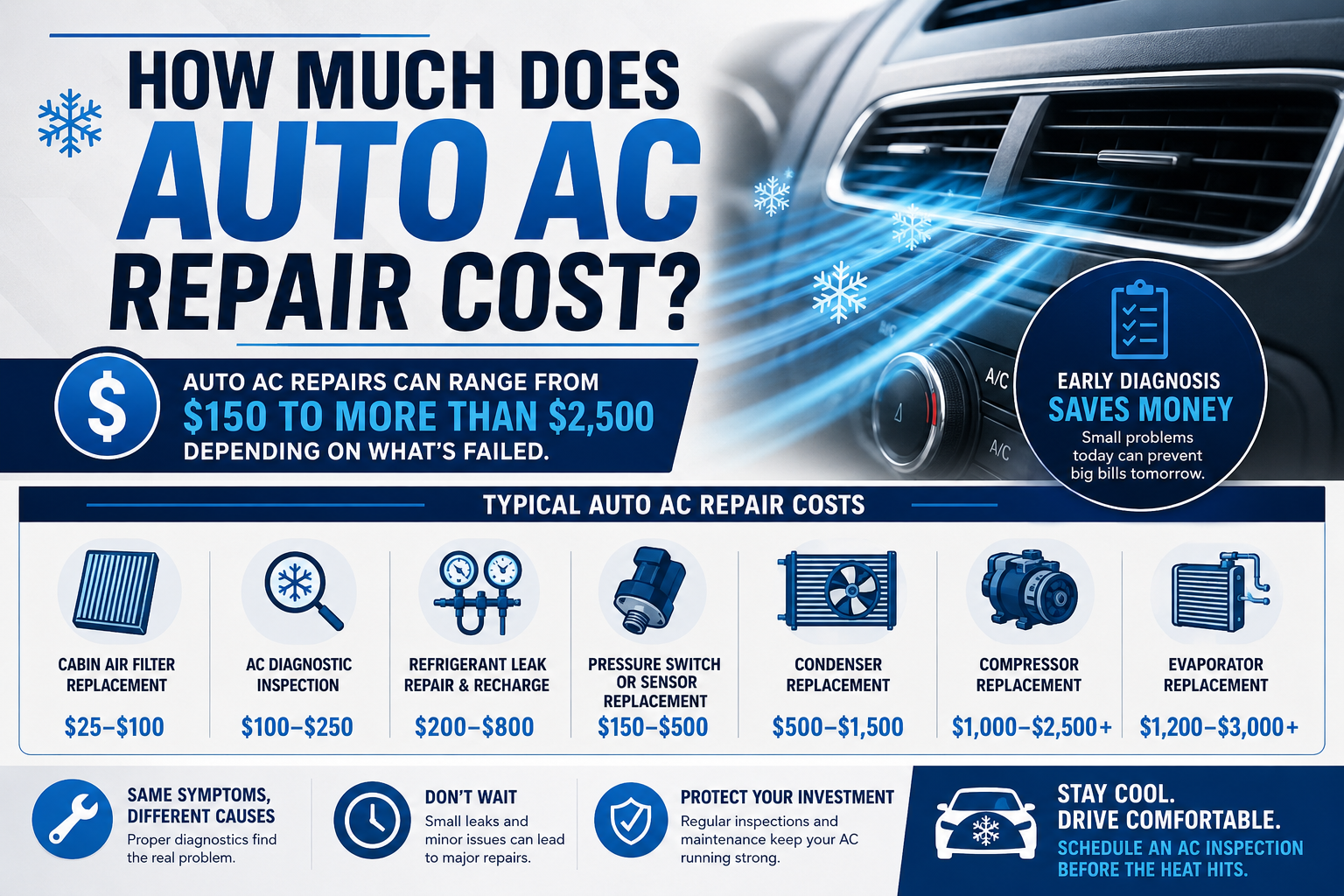
When your car’s air conditioner stops blowing cold air, one of the first questions you may have is: How much is this going to cost to fix?
There isn’t one price for car AC repair because the same symptom can have several very different causes. Warm air could come from a relatively minor electrical or airflow issue, a refrigerant leak, or a more involved repair such as a failed compressor or evaporator.
As a general estimate, car AC repairs can range from around $100 for minor repairs to $3,000 or more for major component replacement. Your actual cost will depend on the vehicle, refrigerant type, parts required, labor involved, and the problem found during diagnosis.
If your AC isn’t cooling properly, FastLap Auto Repair provides professional car AC repair in Oklahoma City to diagnose the problem before recommending a repair.
Average Car AC Repair Costs
The following ranges can give you a general idea of what different AC repairs may cost. These are estimates rather than quotes, and actual pricing can vary considerably by vehicle and repair.
| AC Service or Repair | Estimated Cost Range | What It Does |
|---|---|---|
| Cabin Air Filter Replacement | $25–$100 | Replaces a restricted filter that can reduce airflow through the vehicle’s HVAC system. |
| AC Diagnostic Inspection | $100–$250 | Evaluates AC temperatures, pressures, electrical components, airflow, and system performance to identify the cause of poor cooling. |
| Refrigerant Leak Repair & Recharge | $200–$800+ | Locates and repairs a refrigerant leak before restoring the correct refrigerant charge. |
| Pressure Switch or Sensor Replacement | $150–$500+ | Replaces a failed sensor or switch involved in monitoring and controlling AC system operation. |
| Expansion Valve Replacement | $250–$900+ | Replaces the component responsible for controlling refrigerant flow into the evaporator. |
| Condenser Replacement | $500–$1,500+ | Replaces a leaking, damaged, or failed condenser responsible for releasing heat from the refrigerant. |
| AC Compressor Replacement | $1,000–$2,500+ | Replaces the component responsible for pressurizing and circulating refrigerant through the AC system. |
| Evaporator Replacement | $1,200–$3,000+ | Replaces the component that absorbs heat from cabin air. Labor can be significant because the evaporator may be located deep inside the dashboard. |
These figures are general estimates only. Actual AC repair costs vary based on vehicle make and model, refrigerant type, local labor rates, parts availability, system design, and the extent of the repair.
Why One Car AC Repair Costs $300 and Another Costs $2,000
Two vehicles can arrive at a repair shop with exactly the same complaint:
“My AC isn’t blowing cold air.”
One vehicle may have a small refrigerant leak. Another may have a compressor problem requiring significantly more labor and replacement parts.
From the driver’s seat, both problems can feel identical. From a repair standpoint, they’re completely different.
That’s why diagnosing the AC system before replacing components is so important. Warm air is a symptom, not a diagnosis.
If you’re trying to understand why your system isn’t cooling, our guide to why a car AC blows hot air explains several of the most common causes.
What Affects the Cost of Car AC Repair?
Several factors can change what you’ll ultimately pay for an AC repair.
Vehicle Make and Model
AC system design varies significantly between vehicles. Component location, parts availability, refrigerant capacity, and the amount of labor required to access a failed component can all affect repair costs.
Refrigerant Type
Different vehicles use different refrigerants. The refrigerant required by your vehicle can affect the cost of AC service or recharge.
The Component That Failed
Replacing a sensor or cabin air filter is very different from replacing an evaporator buried behind the dashboard. Parts and labor both contribute to the final repair price.
Whether Additional Damage Has Occurred
Some failures can affect other components. A compressor failure, for example, may require additional system inspection and service depending on how the compressor failed.
Labor Required
Some AC components are relatively accessible, while others require substantial disassembly. Labor time can therefore account for a significant portion of certain repairs.
What Are Some of the Less Expensive Car AC Repairs?
Not every air-conditioning problem requires a major repair.
Depending on the diagnosis, less involved problems may include:
- A restricted cabin air filter
- A failed relay or fuse
- A pressure sensor or switch problem
- Certain electrical faults
- Some refrigerant leaks
For example, weak airflow from the vents doesn’t necessarily mean the refrigeration system itself has failed. A severely restricted cabin air filter or blower-related issue can also reduce airflow.
This is another reason diagnosis should come before assuming the most expensive component has failed.
How Much Does It Cost to Repair a Car AC Refrigerant Leak?
A refrigerant leak repair and recharge may cost approximately $200 to $800 or more, depending on where the leak is located and which component requires repair or replacement.
Common leak locations can include:
- O-rings and seals
- Hoses and connections
- The condenser
- Compressor seals
- The evaporator
Automotive AC systems are designed as closed systems. If the refrigerant level is significantly low, the reason for the loss should be investigated rather than assuming refrigerant simply needs to be added.
Why Recharging the AC Isn’t Always the Repair
Adding refrigerant may temporarily restore cooling if the system is low, but it doesn’t repair the source of a leak.
It’s similar to repeatedly adding air to a tire that has a puncture. The symptom may temporarily improve while the underlying problem remains.
A proper AC inspection can help identify whether refrigerant has been lost and determine where the system may be leaking.
How Much Does Car AC Compressor Replacement Cost?
AC compressor replacement is typically one of the more expensive automotive air-conditioning repairs. A general estimate is approximately $1,000 to $2,500 or more.
The AC compressor acts as a pump for the system, pressurizing and circulating refrigerant through the refrigeration cycle.
If the compressor stops operating properly, the AC may no longer be able to cool the cabin effectively.
Signs of a Possible AC Compressor Problem
Symptoms that may be associated with compressor or compressor-control problems include:
- Warm air from the vents
- Intermittent cooling
- Unusual noises when the AC operates
- Cooling that changes under different driving conditions
- An AC system that stops cooling completely
These symptoms don’t automatically mean the compressor has failed. Low refrigerant, electrical faults, sensors, controls, and other AC components can create similar symptoms.
How Much Does Car AC Condenser Replacement Cost?
A condenser replacement may cost approximately $500 to $1,500 or more, depending on the vehicle, part required, refrigerant service, and labor involved.
The AC condenser is a heat exchanger located near the front of many vehicles. Hot, high-pressure refrigerant travels through the condenser, where heat is released before the refrigerant continues through the system.
Because of its location, the condenser can be vulnerable to:
- Road debris
- Physical impact
- Corrosion
- Refrigerant leaks
- Restricted airflow
A damaged or inefficient condenser can contribute to poor AC performance, particularly when outside temperatures are high or airflow across the condenser is limited.
How Much Does Car AC Evaporator Replacement Cost?
Evaporator replacement can be one of the most labor-intensive AC repairs and may cost approximately $1,200 to $3,000 or more.
The evaporator absorbs heat from air inside the vehicle. The blower motor moves air across the cold evaporator before sending that air through the cabin vents.
On many vehicles, the evaporator is located inside the dashboard. Reaching it can require substantial interior disassembly, which is why labor can make evaporator replacement expensive.
Can Electrical Problems Cause Expensive-Looking AC Symptoms?
Yes. Modern vehicle air-conditioning systems rely heavily on electrical components and electronic controls.
Potential problems can involve:
- Pressure sensors
- Relays and fuses
- Wiring
- Temperature sensors
- Cooling fans
- Control modules
- Blower controls
An electrical problem can sometimes produce symptoms that resemble refrigerant or compressor failure. That’s why testing the system before replacing major components is important.
FastLap also provides vehicle diagnostic services when symptoms require further electrical or system testing.
What Happens During a Car AC Inspection?
A professional AC diagnosis involves more than checking whether the vents feel cold or simply adding refrigerant.
Depending on the vehicle and symptoms, technicians may evaluate:
- Vent temperature
- System pressures
- Refrigerant condition and charge
- Potential refrigerant leaks
- Compressor operation
- Condenser condition
- Cooling fan operation
- Electrical components
- Blower motor and airflow
- Cabin air filter condition
- HVAC controls and sensors
The objective is to identify the actual cause of the cooling problem before recommending repairs.
Can Fixing an AC Problem Early Save Money?
Addressing a developing AC problem early can sometimes prevent additional issues, but the outcome depends on what’s actually wrong with the system.
For example, continuing to operate a system with an unresolved leak or mechanical problem may place additional stress on other components.
Changes worth having inspected include:
- Cooling that has gradually become weaker
- AC that works intermittently
- Unusual noises when the AC is running
- Weak airflow from the vents
- Cooling that changes dramatically between driving and idling
- AC that takes considerably longer to cool the cabin
AC performance can be reviewed alongside other routine preventative maintenance services to help identify developing vehicle concerns.
Car AC Repair Cost FAQs
What is the average cost to fix a car AC?
Car AC repair can range from around $100 for relatively minor problems to $3,000 or more for major component replacement. The actual cost depends on the vehicle and the component or system causing the problem.
How much does it cost to recharge a car AC?
Recharge costs vary based on the vehicle, refrigerant type, system capacity, and whether leak diagnosis or repair is required. If the system is low on refrigerant, determining why it is low is an important part of the repair.
How much does it cost to fix a refrigerant leak?
A leak repair and recharge may cost approximately $200 to $800 or more. A simple seal or connection leak can cost considerably less to repair than a leaking evaporator or condenser.
How much does an AC compressor cost to replace?
A compressor replacement may cost approximately $1,000 to $2,500 or more depending on the vehicle, compressor, labor, refrigerant service, and whether additional AC-system work is necessary.
Why is car AC repair so expensive?
Some AC repairs require expensive components, specialized refrigerant equipment, diagnostic testing, and significant labor. Components such as evaporators may also be difficult to access, increasing the labor required for replacement.
Does warm air mean my AC compressor is bad?
No. Warm air can result from several problems, including low refrigerant, leaks, condenser or cooling fan problems, electrical faults, HVAC controls, and compressor issues. The system should be diagnosed before assuming the compressor needs replacement.
Is it worth repairing the AC in an older car?
That depends on the repair required, the overall condition and value of the vehicle, and how long you plan to keep it. Getting an accurate diagnosis and repair estimate makes it easier to compare the AC repair cost with the vehicle’s overall condition.
Car AC Repair in Oklahoma City, OK
The cost of repairing your car’s air conditioner ultimately depends on the problem causing the symptom. Warm air doesn’t automatically mean you need a compressor, and weak cooling doesn’t automatically mean the system only needs refrigerant.
If your vehicle isn’t cooling properly, FastLap Auto Repair can inspect the system and determine what’s causing the problem before recommending a repair.
Learn more about our car AC repair services in Oklahoma City or schedule an appointment with our team.