
Do Turbocharged Engines Need More Frequent Oil Changes?
Yes, turbocharged engines generally benefit from more frequent oil changes than naturally aspirated (non-turbo) engines.
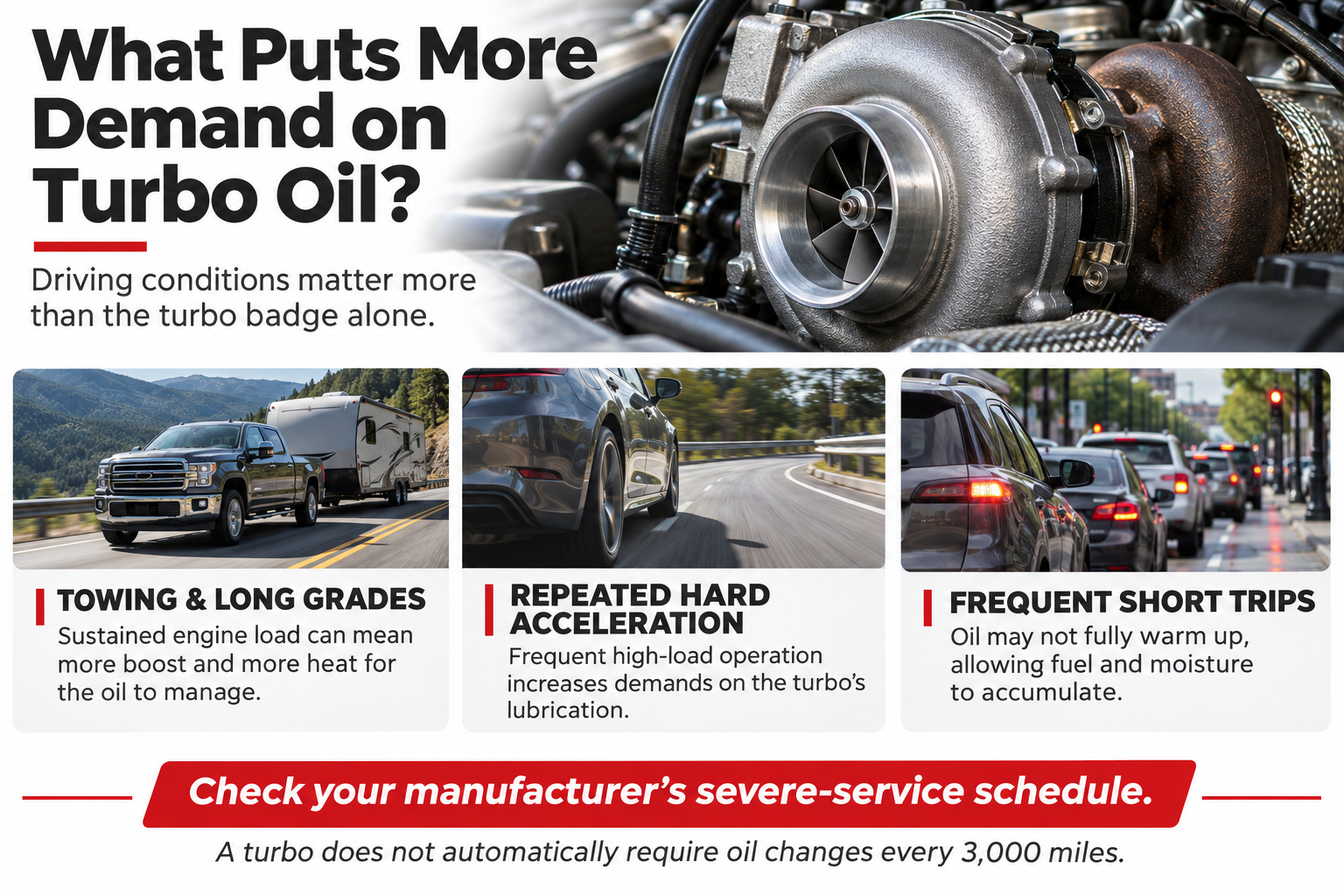
Turbocharged engines may need more frequent oil changes under demanding driving conditions, but having a turbo does not automatically mean your vehicle needs oil changes every 3,000 miles. The correct interval depends on the manufacturer’s maintenance schedule, required oil specification, oil-life monitor, and how you drive.
Turbocharged engines are common in everything from compact cars to family SUVs and pickup trucks. They help smaller engines produce useful power, making them appealing to drivers who want responsive acceleration without moving to a much larger engine.
However, a turbocharger also gives the engine’s lubrication system another demanding job. The same oil that protects the engine may also lubricate the turbocharger’s rapidly rotating components and carry heat away from its bearing housing.
That makes oil selection, oil level, and service timing especially important.
For Oklahoma City drivers, the practical question is not simply whether turbo engines need “extra” maintenance. It is whether your maintenance schedule reflects the way your vehicle is actually used.
Why Turbocharged Engines Need Cleaner Oil
Turbocharged engines put extra demands on engine oil. Along with protecting the engine’s moving parts, the oil lubricates the turbocharger’s bearings and helps carry heat away. Keeping that oil clean and in good condition helps protect both components from premature wear.
- High heat and speed: Turbochargers are powered by hot exhaust gases and can spin at more than 100,000 RPM. These conditions place heavy demands on the oil protecting their bearings.
- Small oil passages: Your turbocharger relies on a steady supply of engine oil flowing through narrow passages. Sludge and deposits can restrict that flow, reducing lubrication and cooling where they are needed most.
- Oil breakdown and carbon deposits: Prolonged exposure to intense heat can degrade oil and leave hardened carbon deposits, a process known as coking. These deposits can restrict oil flow and contribute to turbocharger damage.
- Fuel dilution: During cold starts and certain operating conditions, some fuel can get past the piston rings and mix with the oil. Excessive fuel dilution thins the oil and reduces its ability to protect moving parts, particularly when frequent short trips prevent the engine from fully warming up.
Using oil that meets your vehicle manufacturer’s specifications and following the recommended oil-change schedule helps keep your engine and turbocharger properly protected.
A turbocharger uses energy from exhaust gases to drive a turbine. That turbine is connected by a shaft to a compressor, which pushes additional air into the engine.
The rotating assembly needs a reliable supply of clean oil. Depending on the turbocharger’s design, the lubrication system supports journal bearings, ball bearings, thrust components, or a combination of these parts.
Oil does several jobs at once. It reduces friction, helps manage heat, and carries contaminants away from lubricated surfaces.
Problems arise when the oil supply becomes restricted, the oil level drops, or contamination interferes with lubrication. Turbocharger manufacturer Garrett identifies oil starvation and oil contamination as important causes of turbocharger damage. Source: Garrett
This does not mean turbochargers are inherently fragile. It means their maintenance requirements deserve the same attention as their performance benefits.
Keeping up with oil changes in Oklahoma City is one way to protect that system. Using the correct oil and checking its level between services are equally important.
Does Every Turbo Engine Need a Shorter Oil Change Interval?
No. Manufacturers establish maintenance requirements for the engine as designed, including its turbocharger.
If your owner’s manual specifies a certain interval for your turbocharged engine under normal operation, that recommendation already accounts for the engine’s configuration. You do not need to assume the manufacturer forgot about the turbo.
The complication is that normal and severe operating conditions are different.
A vehicle used mainly for longer highway trips may accumulate mileage with relatively few cold starts. Another vehicle may cover fewer miles while idling for hours, making short trips, or towing a trailer.
Those vehicles can place very different demands on their oil.
Rather than following a universal “turbo rule,” identify:
- The maintenance schedule for your exact engine
- Whether your driving meets the manufacturer’s severe service definition
- The required oil viscosity and performance specification
- Any calendar limit on oil changes
- How the vehicle’s oil life monitoring system should be used
If the manual lists separate schedules, choose the one that matches your driving.
Driving Conditions That Can Shorten Oil Life
Frequent short trips
A five-minute drive may warm the cabin without bringing the engine oil fully to operating temperature.
Repeated short trips can allow moisture and fuel contamination to accumulate, particularly in cooler weather. Starting the engine frequently while giving it little sustained operating time can be more demanding than the low mileage suggests.
A turbocharged commuter vehicle used for short errands may therefore need a different maintenance approach from a similar vehicle used for long highway drives.
Extended idling
Idling adds engine operating time without adding much mileage.
Drivers who wait in pickup lines, work from their vehicles, or spend long periods in traffic should consider that operating time when reviewing maintenance requirements.
The odometer is useful, but it does not measure every condition that affects oil.
Towing and hauling
Pulling a trailer or carrying substantial loads increases engine demand. A turbocharged engine may operate under boost more frequently while maintaining speed on grades or accelerating with the additional weight.
That can increase thermal stress on the oil.
The manufacturer may specify different maintenance requirements for regular towing, even if the same vehicle has a longer interval under ordinary commuting conditions.
Dusty operation
Dust can affect the engine when air filtration or intake sealing is inadequate. Driving on unpaved roads also makes regular air filter inspections more important.
Changing the oil does not correct a damaged air filter housing or an intake leak. Those conditions need inspection.
Repeated high-load driving
Frequent hard acceleration, sustained high-speed operation, and track use can create maintenance needs beyond those of ordinary street driving.
A vehicle used for performance driving should follow the manufacturer’s applicable instructions, including any track-specific oil requirements.
Why the Correct Oil Matters More Than the Word “Synthetic”
Many turbocharged engines require full synthetic oil, but “full synthetic” alone is not enough information to select the right product.
An oil must also meet the required viscosity grade and performance specifications.
For example, two bottles labeled 5W-30 can have different manufacturer approvals. One may meet the requirements for a particular engine while the other does not.
Those differences can involve deposit control, oxidation resistance, wear protection, emissions-system compatibility, and other performance characteristics.
Some modern turbocharged gasoline engines also require oils formulated to help address low-speed pre-ignition, an abnormal combustion event associated with certain engine designs.
The safest approach is to match the exact requirements in the owner’s manual or the current manufacturer’s service information.
An oil that is expensive, heavily advertised, or marketed for racing is not automatically the best choice for your daily driver.
Should You Change Turbo Engine Oil Every 3,000 Miles?
A 3,000-mile interval may be appropriate for some vehicles and operating conditions, but it is not a universal requirement.
Automatically changing oil very frequently can add expense without addressing the most important maintenance questions. Conversely, extending service simply because the oil is synthetic can create problems if the vehicle requires a shorter interval.
Consider two hypothetical situations.
A driver whose manual specifies a shorter interval for repeated towing should follow that requirement even if an oil bottle advertises extended performance.
Another driver whose vehicle permits a longer interval under normal use does not necessarily benefit from cutting that interval in half without a reason.
If you are uncertain, bring your service records and describe your driving habits when you schedule automotive maintenance at FastLap.
That conversation is more useful than choosing a mileage number based on the presence of a turbo badge.
Understanding the Oil Life Monitor
Many vehicles calculate remaining oil life using operating information such as engine temperature, driving time, mileage, and other inputs.
The calculation varies by manufacturer and vehicle.
An oil-life percentage is generally a maintenance estimate. It should not be confused with the amount of oil in the engine.
For example, 40% oil life remaining does not mean the engine contains 40% of its required oil. A vehicle can display remaining oil life while being low on oil because of a leak or oil consumption.
Follow the manufacturer’s instructions for responding to the monitor, checking the oil level, and observing any maximum time interval.
The monitor must also be reset correctly after service. Resetting it without changing the oil makes the displayed information misleading.
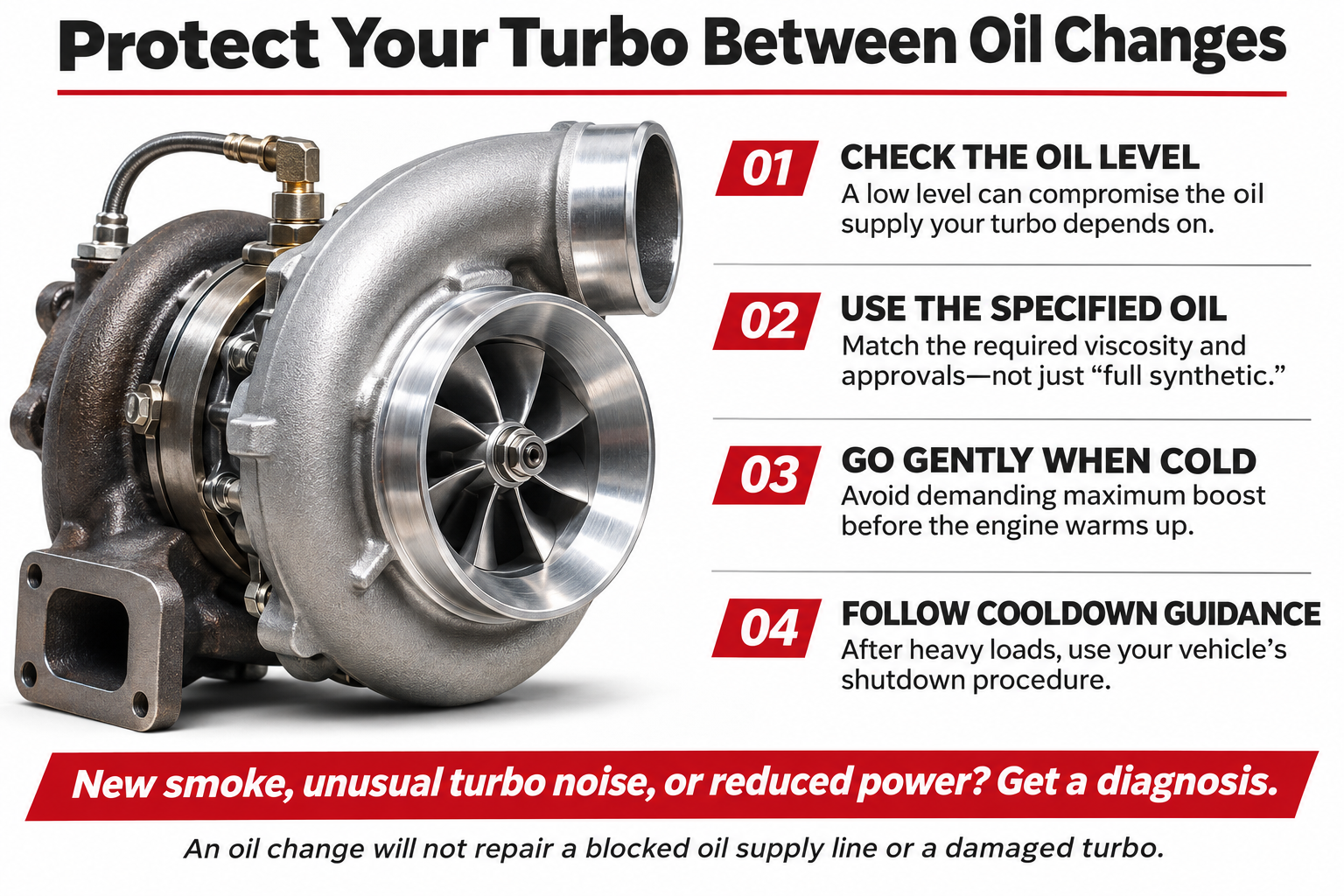
Check Oil Level Between Changes
Turbocharged engines should not be treated as maintenance-free between oil-change appointments.
Some engines consume oil during operation. Others develop leaks around gaskets, seals, filter housings, or turbocharger oil lines.
A declining level reduces the available oil supply.
Check the oil according to the owner’s manual. Some vehicles use a dipstick; others use an electronic measurement procedure that requires specific operating conditions.
For a dipstick-equipped vehicle, the general process usually involves parking on level ground, following the specified engine temperature and waiting instructions, removing and wiping the dipstick, then reinserting it fully before reading.
Do not assume the space between the marks represents the same quantity on every vehicle.
Add only the specified oil, in controlled amounts, and avoid overfilling.
If you repeatedly need to add oil, record how much you add and the mileage between additions. That information helps distinguish a stable pattern from a developing problem.
Can Oil Changes Prevent Turbo Failure?
Proper oil service can reduce avoidable lubrication related risk, but it cannot prevent every turbocharger problem.
A turbocharger may also be affected by foreign object damage, air leaks, exhaust restrictions, control-system problems, or issues elsewhere in the engine.
Likewise, changing the oil will not repair a blocked oil supply line or a malfunctioning crankcase ventilation system.
If your vehicle develops new smoke, unusual noises, reduced power, or a warning light, the problem needs a diagnosis.
A faint turbo sound that has always been present is different from a new siren-like noise or sudden change in performance. Describe when the symptom occurs and whether it changes with acceleration, temperature, or engine speed.
FastLap’s auto repair services can help you determine whether a concern is a routine maintenance issue or a mechanical fault.
Does a Turbo Engine Need to Idle Before Shutdown?
There is no single shutdown rule for every turbocharged vehicle.
Modern turbo systems vary in cooling design, oil circulation, and electronic control. Some manufacturers provide specific instructions after towing, sustained high load operation, or other demanding use.
Follow those instructions.
For ordinary driving, avoid prolonged idling solely because an older turbocharged vehicle required it. Unnecessary idling adds engine time and fuel use.
A sensible general habit is to avoid aggressive operation immediately before parking, while still following the vehicle’s stated procedure.
Similarly, after a cold start, drive gently until the vehicle warms rather than demanding maximum boost immediately.
The details matter more than a universal stopwatch rule.
What Should a Turbo Engine Oil Change Include?
The core service involves draining the used oil, replacing the filter as required, and filling the engine with the correct quantity of approved oil.
A proper service also requires attention to the drain plug, sealing components, filter installation, final oil level, and leaks.
For turbocharged vehicles, maintenance records are particularly useful. They should identify the oil used, mileage, service date, and any findings.
If you have noticed oil consumption, smoke, or unusual sounds, mention them before the service begins. An oil change appointment does not automatically include a full turbocharger diagnosis.
Likewise, a routine service cannot establish that every internal engine component is healthy. It provides an opportunity to identify concerns and decide whether additional testing is needed.
Fall Car Care for Turbocharged Vehicles
Fall is a useful time to review maintenance after summer driving and before cooler weather and holiday travel starts, changing road conditions.
For a turbocharged vehicle, begin with the oil service history and oil level. Then consider the cooling system, battery, air filter, tires, brakes, and windshield visibility.
A weak battery or worn tire can interrupt a trip just as effectively as an engine problem.
Drivers planning seasonal travel can use the Car Concepts fall car care checklist to organize a broader inspection.
If you are planning a long drive from Oklahoma City, calculate the expected round-trip mileage before deciding whether your next oil change can wait until you return.
Frequently Asked Questions
Is synthetic oil better for a turbocharged engine?
Many turbocharged engines require synthetic oil because of their lubrication and temperature demands. The correct product is the one meeting the engine’s specified viscosity and approvals.
Can I use a thicker oil to protect the turbo?
Not unless the manufacturer permits that grade for your application. Thicker oil is not automatically more protective and can affect circulation and oil-operated engine systems.
Does dark oil mean the turbo is damaging it?
No. Oil color alone cannot identify turbocharger damage or determine remaining oil life. Service history, operating conditions, oil level, and diagnostic findings are more informative.
Should I shorten oil changes if I mostly drive in traffic?
Possibly. Review the severe service criteria for your vehicle. Heavy traffic and extended idling may affect maintenance requirements, but the specific schedule should come from the manufacturer.
Can I drive with an oil-pressure warning?
An oil pressure warning while the engine is running requires immediate attention. Safely stop, switch off the engine, and follow the owner’s manual. Do not assume a routine oil change will make continued driving safe.
Schedule Turbo Engine Maintenance in Oklahoma City
A turbocharged engine does not need guesswork. It needs the correct oil, a suitable service interval, and attention to changes in oil level or performance.
If you are unsure whether your current maintenance schedule fits your driving, schedule an oil change with FastLap Auto Repair. Bring your vehicle information and service history so the oil requirements and next maintenance steps can be reviewed together.